| Anghiari Home | Anghiari Churches and Pievi | Anghiari Castles and Villas |
|
The territory around Anghiari boasts a number of very early parish churches. These are known as "pievi" (singular "pieve"), a word derived from the latin "plebes" (the common people). They were built during the early phases of christianisation in which baptism was a crucial element. The pievi remained for centuries the only places authorised to carry out baptisms. |
The Pieve di Santa Maria a Corsano |
|
| The Romanesque
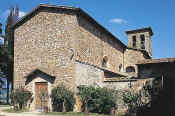
parish church of Santa Maria a Corsano
is located near the village of San Leo di Anghiar on the road between Sansepolcro
and
Arezzo. It is a 12 C church probably built by the Camaldulian Order on the foundations of a
Roman temple. The church is next to the old road between Anghiari and Citerna and near a spring at the top of
an ancient river bank. This is where the River Tiber used to flow before it
moved nearer to Sansepolcro in the remote past. The belfry is unusual in being positioned in the middle of the front façade instead of at the back, with the main church entrance going through its base. The interior is Renaissance with interesting decorations on the stone arches and pilasters. The 17 C main altar is decorated with a beautiful Madonna of the Milk, suggesting a connection between popular local beliefs and the spring in the grounds of the ancient temple. There is also a votive offering inside the church in the form of a fairly crudely painted fresco from the Renaissance era, with a readable inscription stating "Evangelista di Compagno had this picture made". Santa Maria a Corsano was confiscated by the State in 1866 and sold, together with its land. It has subsequently been re-opened for religious use and was restored but now shows signs of neglect. It is nevertheless a fine example of Romanesque architecture. |
|
The Pieve di Santa Maria alla Sovara |
|
| The
parish church of Santa Maria della Sovara (Santa Maria of the River
Sovara) is located at the foot of the west-facing hillside of Anghiari, near the Libbia road, on a big curve just before the village of
Tavernelle. The earliest documentation for the existence of this church goes back to the
11 C but it is believed to have much earlier origins (7 C or 8 C). The structure
is in the form of a Latin cross with a presbytery and a single nave ending in three apses.
The shape symbolises the Sacred Trinity and supports the theory that the church
originated in a mission to convert the Lombard population to the Arian Catholic religion. Like many other churches in the area, it was linked to the Camaldulians and it was thus the Duke of Milan who protected it against the pressures applied during the 14 C and 15 C against all the Camaldolian possessions by the Tarlati family of Arezzo through their castles at Toppole and Valialle. In the second half of the 1400's, restructuring gave the church the appearance that it has today, with tall stone columns and a slender belfry to one side. |
|
The Pieve di Santa Maria a Micciano |
|
| The Pieve di Santa Maria a Micciano
is located on the slopes above the road from Anghiari to Caprese Michelangelo, just before the village of Motina.
The church faces the fields that surround it and has a line of cypress trees leading up to it. Over the
centuries, additional buildings have accumulated around the church itself. The foundation of this church could be as long ago as the 4 C and up until the 7 C it was the private property of the Lords of Galbino, who were of Lombard origin. At the end of the 11 C, it was given to the Camaldulians and under their Prior Rodolfo it increased enormously in importance. The church gradually acquired huge tracts of land and became the economic centre of the area where agriculture was organised by the Camaldulians using the first forms of sharecropping. In spite of the disagreements with the Diocese of Arezzo regarding control of the church, the Papal Bull of Pope Innocent in 1198 confirmed full possession of the church to the monks. At the beginning of the 20 C, some funerary articles from Roman times were found. |
|
Sanctuary of the Madonna del Carmine |
|
| This
Sanctuary is located on the panoramic road that runs from Anghiari to Ponte alla Piera. The Sanctuary was founded following the apparition of the Madonna to a shepherdess. This event occurred on the 16th of July 1535 and plans for the Sanctuary were initiated immediately by Camerini of Bibbiena, and the sanctuary was built between 1536 and 1552. It was run by the Carmelites until the end of the 18 C, and then entrusted to the Camaldulians. The interior of the church which was built in the form of a Latin cross and its belfry dates from 1566. The painting of the Madonna del Carmine is behind the main altar and is still venerated today by many believers. To one side of the church there is a cloister with the monk's cells. Recent restoration work has returned the building to its original beauty. There are forty beds and a refectory available for groups who wish to stay in this tranquil and spiritual place. |
|
| Anghiari Home | Anghiari Churches and Pievi | Anghiari Castles and Villas |
Anghiari © ammonet InfoTech 2007 - 2010