| Anghiari Home | Churches and Pievi | Castles and Villas |
Anghiari is a Tuscan town that deserves to be better known for its undoubted attractions rather than simply as the location of a battle that is in turn famous more for a lost painting than anything else. In the first place, the panoramic view from Anghiari is truly spectacular, made all the more so by the long, straight road (Via della Battaglia near Anghiari, then Via dei Tarlati further away) running across the flat floor of the Upper Tiber valley from Sansepolcro and up the steep hill to Anghiari. The view towards Anghiari is equally splendid, with the city walls rising up from a steep spur above the Tiber and the Sovara valleys.
![]()
Anghiari
is rated one of the most beautiful villages in Italy
"Uno dei borghi più belli d'Italia"
as are Montefioralle, Scarperia
and
Poppi.
Anghiari is located on the site of a Roman settlement but became prominent in the 11 C because of its strategic position on the trade routes linking central Italy with the Adriatic. The earliest extant reference to the town by name is in a document dated 1048, still preserved in the archives at Città di Castello. At that time the town belonged to the Camaldolesi monks (Order of Romualdo). However, the most important period in the history of the town is associated with the Battle of Anghiari which was fought in 1440 between the Visconti armies from Milan and those of Florence which were allied with the Pope. Machiavelli spoke about the battle in his Historiae fiorentinae and Leonardo da Vinci executed a huge and short-lived fresco of it in Florence.
The powerful monastery of S. Bartolomeo, which was later transformed by the Perugians into a defensive structure, and the Chiesa della Badia were the first large mediaeval buildings in Anghiari. The surrounding 12 C and 13 C wall remains almost intact and the town can be entered through three gateways, Sant Angelo, San Martino and Fiorentina. The apse of the Chiesa di Sant'Agostino and the Bastione del Vicario are actually incorporated into the city wall.
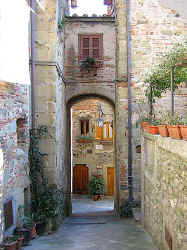
Passage in the historical town centre of Anghiari
The town centre was expanded in the 14 C when the Tarlati family commissioned the long road that leads to Sansepolcro and the loggia with fountains
located below Piazza Baldaccio (formerly Piazza del Mercatale),.
Piazza Mameli (formerly known as "L'antica piazza del Borghetto") in the heart of the town,
is the home of the two main museums of Anghiari, Palazzo del Marzocco and Palazzo
Taglieschi.
Outside the walls of the Anghiari, passing through the Galleria Girolamo Magi,
there is a fine assembly of 18 C buildings around the Palazzo Corsi. These were commissioned by Benedetto Corsi between 1777 and
1794 and include the Palace itself, which today houses the Biblioteca and Archivio Comunale, the Cappella
Votiva and the Theatre.
|

Palio della Battaglia
Anghiari is famous for a battle fought and won on its territory on Wednesday 29th June 1440 by the Florentine Republic led by Micheletto Attendolo and Giampaolo Orsini against the Milanese army led by Niccolò Piccinino. When Machiavelli subsequently
wrote about the battle, he sarcastically remarked that twenty four hours of skirmishing produced
only a single death and that was when a soldier fell off his horse. Nevertheless, historically the outcome of the battle was very important
because it kept central Italy in the hands of the Florentines and, indeed, Machiavelli commented much more seriously on this
aspect in his Historiae fiorentinae.
Although the battle was important in its day, it would almost certainly have
faded from memory if the Magistrati of Florence had not decided to decorate the walls of the main Chamber
the Palazzo Vecchio with scenes celebrating the victories of the Florentine armies. Michelangelo was commissioned to paint the Battle of Cascina and Leonardo da Vinci the Battle of Anghiari.
Leonardo created full-scale preliminary drawings and made a start transferring
these onto the wall of Palazzo Vecchio. He painted the central section showing
"The Fight for the Standard". Unfortunately Leonardo's love of experimentation caused the painting to be damaged during the drying process and the uncompleted painting
decayed. Eventually it was replaced by the existing fresco by Vasari. Even while Leonardo was working on his painting, it was lauded as a major innovative work so that many artists came to learn from it and make copies of
it. This lost masterpiece thus lives on in the version by Rubens in the Louvre and that of Biagio di Antonio (1470) of the school of Paolo Uccello, which is in the National Gallery of Ireland in Dublin.
|
Pubblicizza qui la tua attività e vedi ora i risultati! Vorresti pubblicizzare la tua attività su questo sito web per Sansepolcro e ricevere traffico in entrata dalla nostra rete di più di 50 portali relativi? Clicca qui per ulteriori dettagli in merito alla nostra soluzione integrata per una presenza su internet piena di successi. |
| Anghiari Home | Churches and Pievi | Castles and Villas |